Skip to main content arrow_circle_down
Harvard University
China Biographical Database Project (CBDB)
  • HOME
  • About Us
    • History of CBDB
    • Core Institutions and Editors
    • Funders
    • Collaborators
    • Working Groups for Historical Periods
    • Technical Development and Text Mining
    • Current Subprojects in Harvard
    • Past Subprojects in Harvard
    • Crowdsourcing Projects
    • Open Source Community(GitHub)
    • Exclusive Commercial License
    • Visiting CBDB Cambridge
  • Methodology
    • Prosopography
    • GIS: Mapping and Analyzing
    • Social Networks
  • Sources
    • How CBDB collects data and why you do not always find what you want
    • CBDB Sources
    • Coverage of CBDB
    • Structure of CBDB
  • Events
    • CBDB 20th Anniversary Symposium
    • Cyberinfrastructure Conference
    • International conference on the cyberinfrastructure for historical China studies
    • 2007 Prosopography of Middle Period China
    • 2008 First International Workshop on Biographical Databases for China's History
    • 2010 Computational Method & China's History
    • 2013 Tang Workshop
    • 2014 Training Workshops around the World
    • 2015 Training Workshops around the World
    • 2016 Training Workshops around the World
    • 2016 Keynote Talk on CBDB by Professor Ping-tzu Chu in Taiwan
    • Plan for a Conference on Cyberinfrastructure
  • Download Center
    • Download CBDB Standalone Database
    • Supporting Documents
    • Presentations and Papers
    • Download Supporting Software
    • CBDBRegexMachine
    • Data Sets
    • CBDB API
    • CBDB Linked Open Data
    • Report an Error
  • Blog
    • Newest blogs
    • Previous blogs
  • 中文

Breadcrumbs

  1. Home chevron_right
  2. Galleries chevron_right
  3. >>> A Spatio-Temporal Database of Eminent Monks in China (Ven. Huimin, Fayuan)

>>> A Spatio-Temporal Database of Eminent Monks in China (Ven. Huimin, Fayuan)
Created on : July 29, 2015

A Spatio-temporal Database of Eminent Monks in China
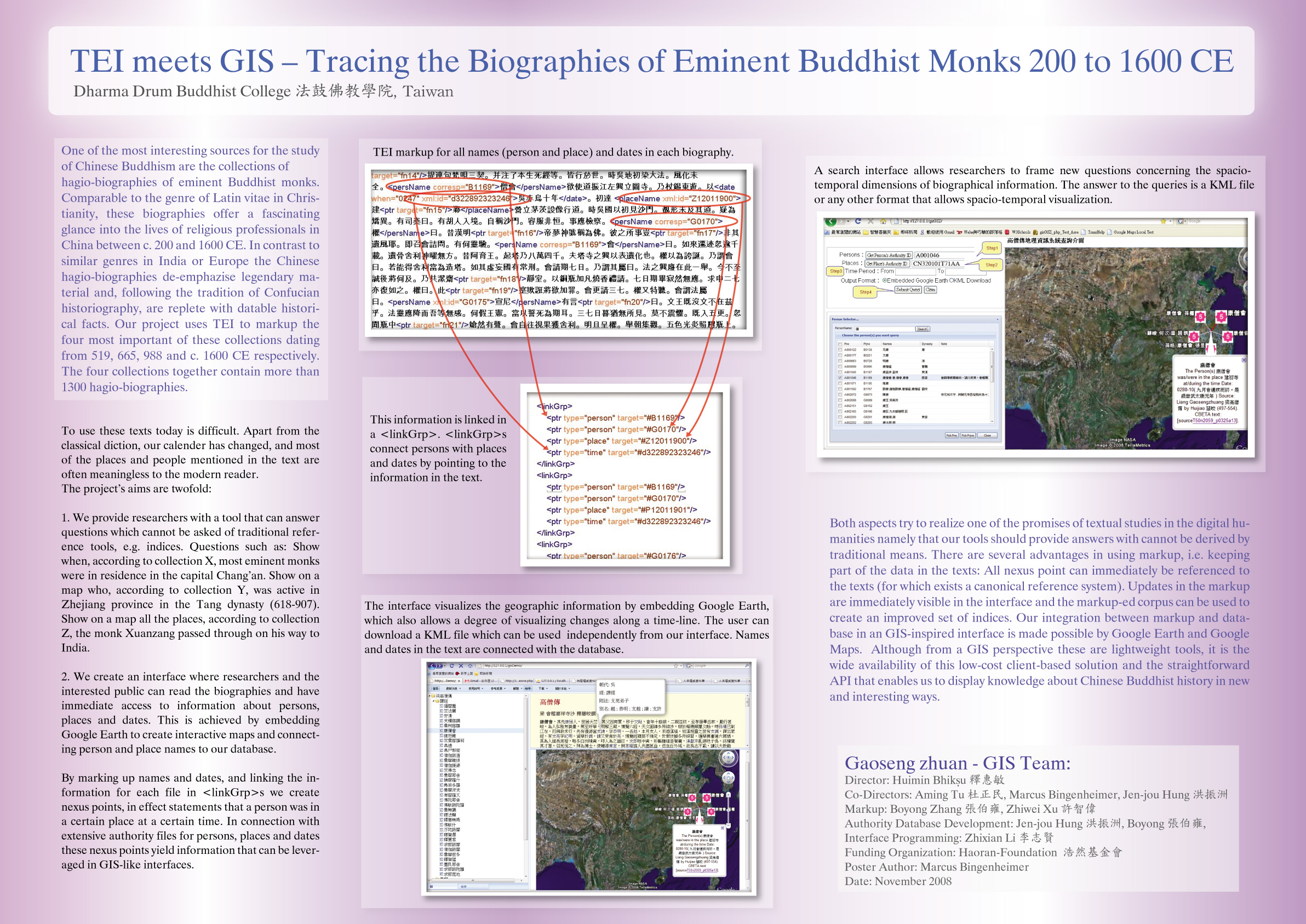
Conference poster 'TEI meets GIS - Tracing the Biographies of Eminent Buddhist Monks 200 to 1600 CE', with TEI markup samples and map screenshots.
Title slide: A Spatio-temporal Database of Eminent Monks in China, by Ven. Huimin and Fayuan, 22 November 2008.
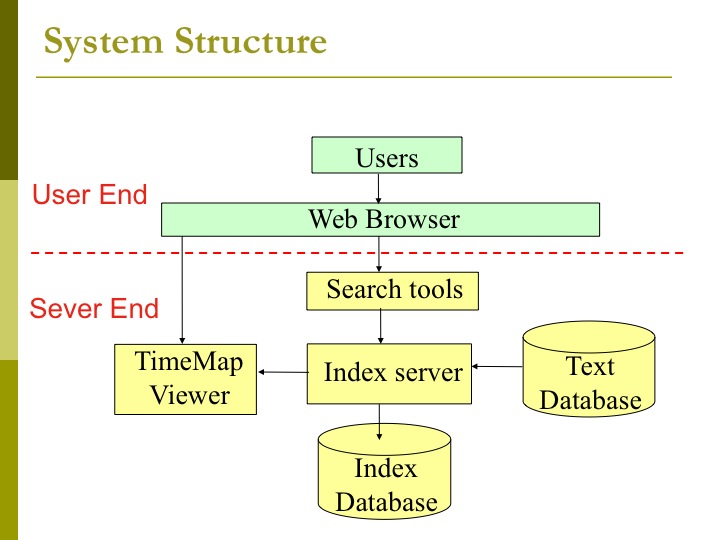
Diagram 'System Structure': users and a browser at the user end; at the server end search tools, an index server, a TimeMap viewer and two databases.
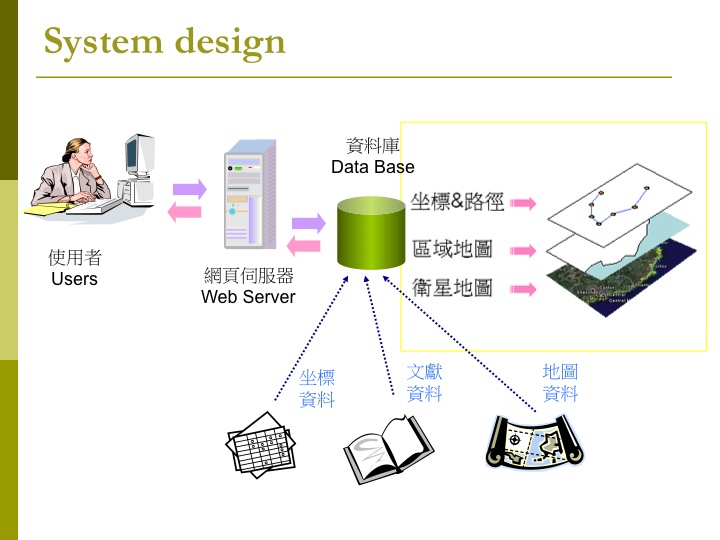
Diagram 'System design': users reach a web server and a database fed by coordinate, textual and map sources, outputting coordinate, area and satellite layers.
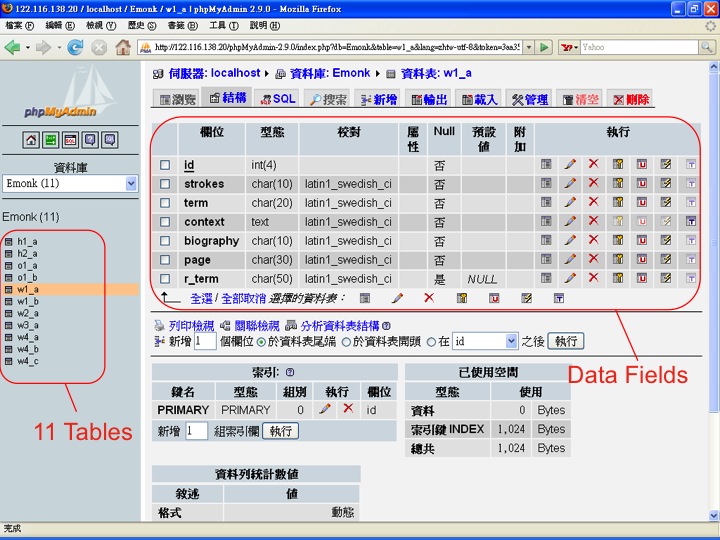
phpMyAdmin screenshot: the Emonk database with 11 tables ringed at left and the fields of table w1_a at right - id, strokes, term, context, biography, page.
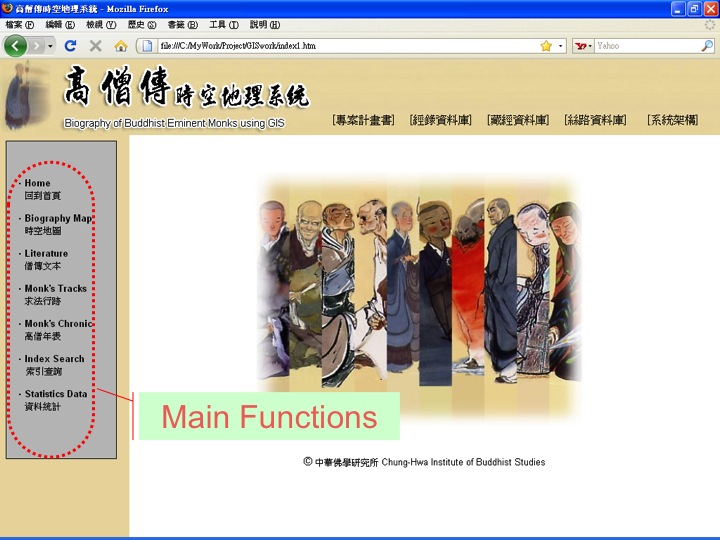
Screenshot of the project home page, Biography of Buddhist Eminent Monks using GIS, its left menu ringed as Main Functions, above a row of monk paintings.
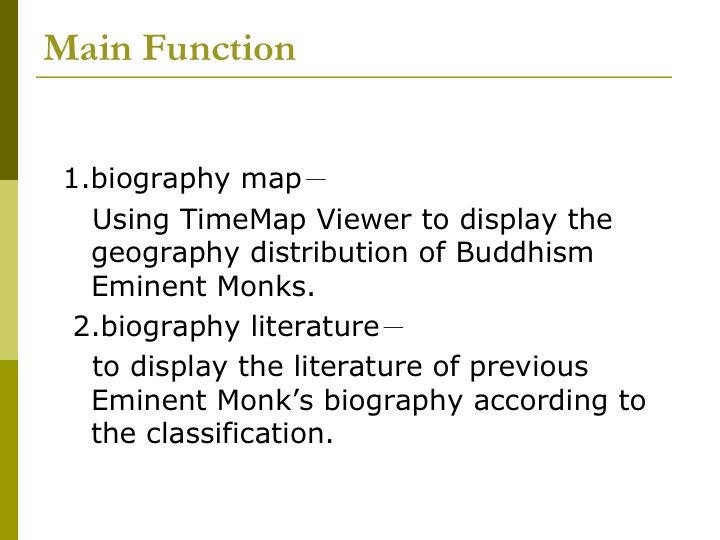
Slide 'Main Function': 1, biography map, using TimeMap Viewer for the geographic distribution of eminent monks; 2, biography literature, by classification.
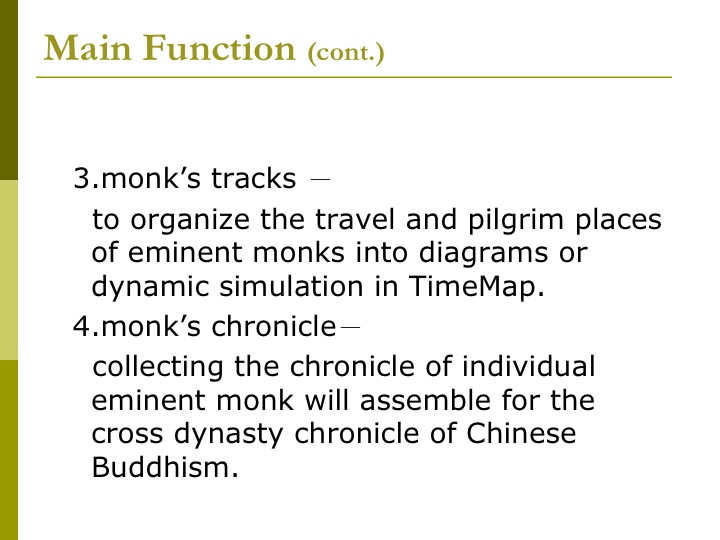
Slide 'Main Function (cont.)': 3, monk's tracks, organising travel and pilgrimage places into diagrams or dynamic TimeMap simulation; 4, monk's chronicle.
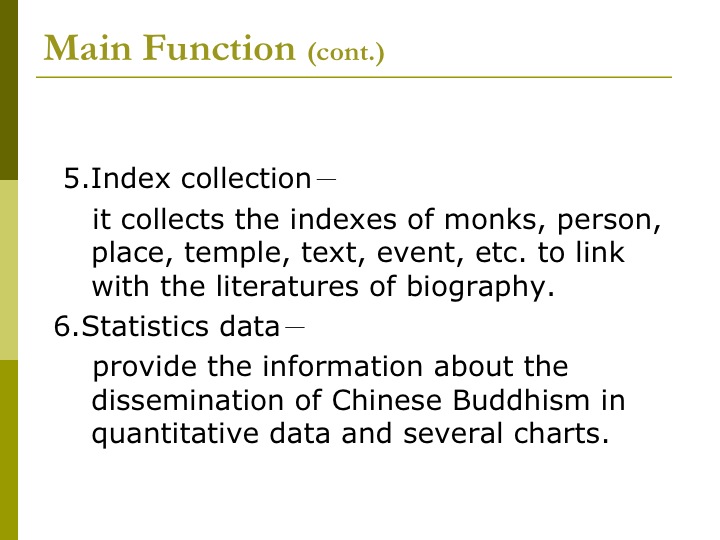
Slide 'Main Function (cont.)': 5, index collection, linking indexes of monks, persons, places, temples and texts to the biographies; 6, statistics with charts.
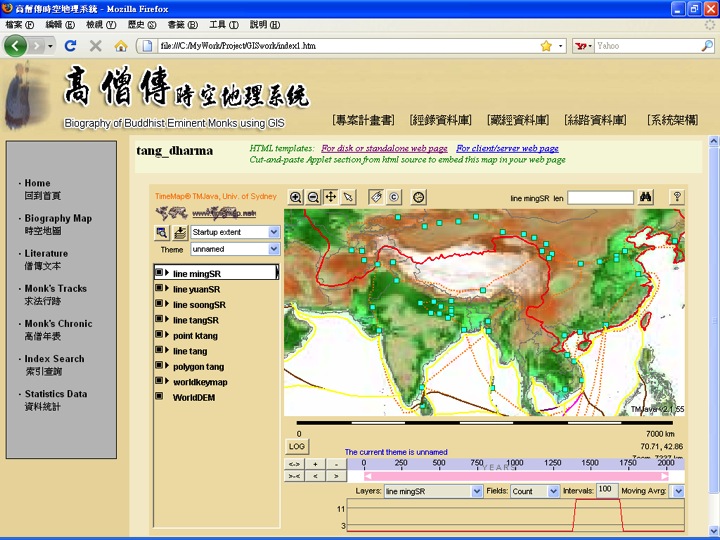
Screenshot of the TimeMap viewer showing tang_dharma: a relief map of Central Asia and China with green markers, a layer list, and a timeline from 0 to 2000.
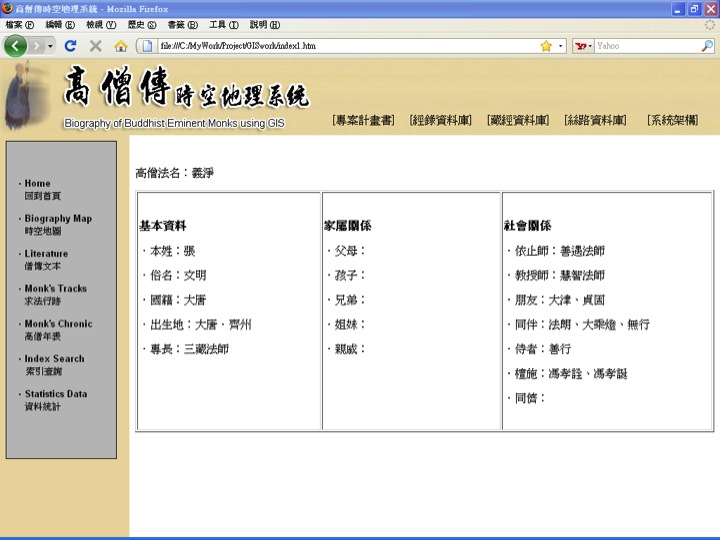
Screenshot of the record for the monk Yijing: three panels giving basic data (lay surname Zhang, born in Qizhou), family relations, and social relations.
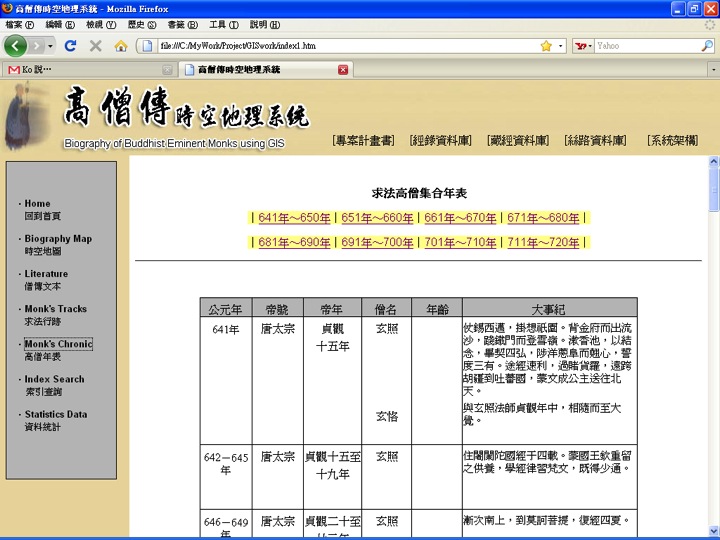
Screenshot of the combined chronicle of dharma-seeking monks: decade links from 641 to 720, and a table of year, reign, monk's name, age and events.
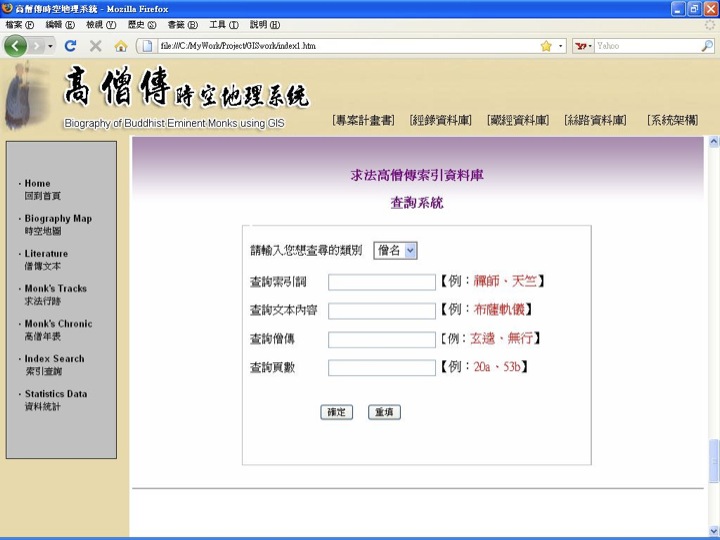
Screenshot of the index search system: a dropdown set to monk's name, with fields for index term, text content, biography and page, each with an example.
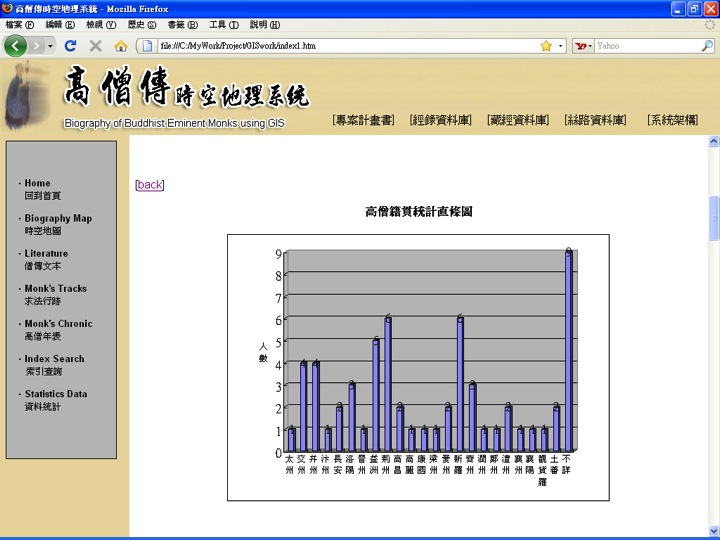
Screenshot of a bar chart of eminent monks' native places: about twenty prefectures, most with one to six monks, the unknown column reaching nine.
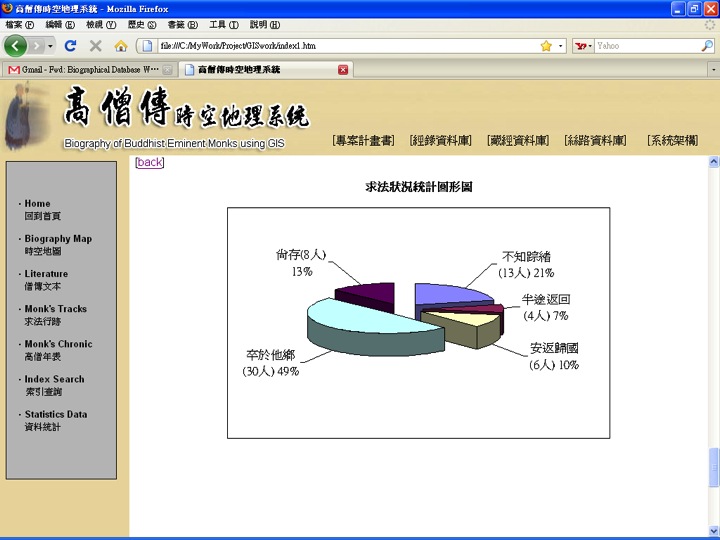
Screenshot of a pie chart on pilgrimage outcomes: died abroad 30 people or 49 per cent, whereabouts unknown 13 or 21 per cent, still alive 8, returned safely 6.
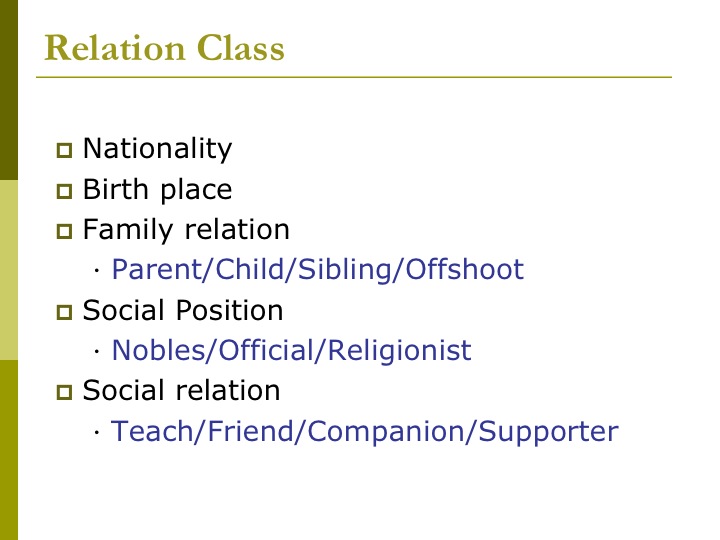
Slide 'Relation Class': nationality, birth place, family relation (parent, child, sibling, offshoot), social position (nobles, official) and social relation.
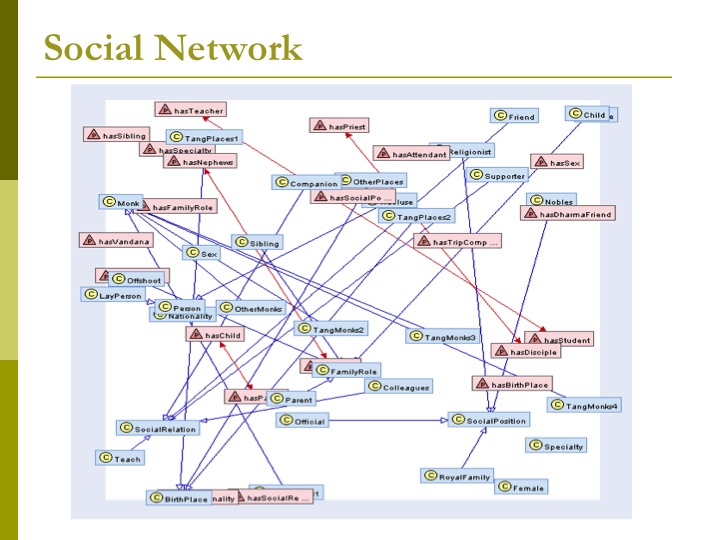
Screenshot of an ontology editor showing the social network schema: classes such as Monk and SocialRelation linked by hasTeacher, hasChild and hasBirthPlace.
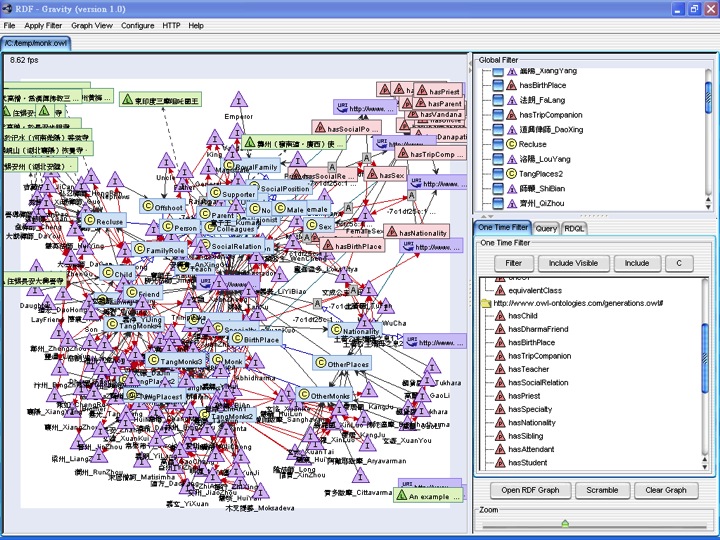
Screenshot of RDF-Gravity showing the monk ontology as a dense graph of purple triangles and red arrows, with filter panels listing the properties.
China Biographical Database Project (CBDB)

© China Biographical Database. Except where otherwise noted, content on this site is licensed under a Creative Commons Attribution-NonCommercial-ShareAlike 4.0 International license.

Admin login
Harvard University
Copyright © 2026 The President and Fellows of Harvard College
Accessibility Digital Accessibility Report Copyright Infringement Info Practices