Skip to main content arrow_circle_down
Harvard University
China Biographical Database Project (CBDB)
  • HOME
  • About Us
    • History of CBDB
    • Core Institutions and Editors
    • Funders
    • Collaborators
    • Working Groups for Historical Periods
    • Technical Development and Text Mining
    • Current Subprojects in Harvard
    • Past Subprojects in Harvard
    • Crowdsourcing Projects
    • Open Source Community(GitHub)
    • Exclusive Commercial License
    • Visiting CBDB Cambridge
  • Methodology
    • Prosopography
    • GIS: Mapping and Analyzing
    • Social Networks
  • Sources
    • How CBDB collects data and why you do not always find what you want
    • CBDB Sources
    • Coverage of CBDB
    • Structure of CBDB
  • Events
    • CBDB 20th Anniversary Symposium
    • Cyberinfrastructure Conference
    • International conference on the cyberinfrastructure for historical China studies
    • 2007 Prosopography of Middle Period China
    • 2008 First International Workshop on Biographical Databases for China's History
    • 2010 Computational Method & China's History
    • 2013 Tang Workshop
    • 2014 Training Workshops around the World
    • 2015 Training Workshops around the World
    • 2016 Training Workshops around the World
    • 2016 Keynote Talk on CBDB by Professor Ping-tzu Chu in Taiwan
    • Plan for a Conference on Cyberinfrastructure
  • Download Center
    • Download CBDB Standalone Database
    • Supporting Documents
    • Presentations and Papers
    • Download Supporting Software
    • CBDBRegexMachine
    • Data Sets
    • CBDB API
    • CBDB Linked Open Data
    • Report an Error
  • Blog
    • Newest blogs
    • Previous blogs
  • 中文

Breadcrumbs

  1. Home chevron_right
  2. Galleries chevron_right
  3. >>> Discussion: Modeling Ming and Qing Lives and Resources for Ming and Qing Biography and Prosopography (Mark Elliott, Martin Heijdra, Michael Szonyi)

>>> Discussion: Modeling Ming and Qing Lives and Resources for Ming and Qing Biography and Prosopography (Mark Elliott, Martin Heijdra, Michael Szonyi)

Created on : July 29, 2015

Discussion: Modeling Ming and Qing Lives and Resources for Ming and Qing Biography and Prosopography
Title slide: Discussion - Modeling Ming and Qing Lives and Resources for Ming and Qing Biography and Prosopography, by Elliott, Heijdra and Szonyi.
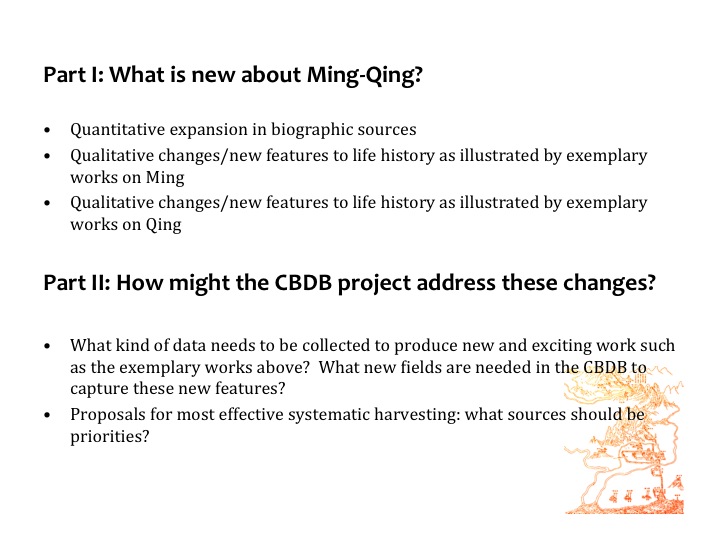
Slide of the two discussion parts: what is new about Ming-Qing, quantitatively and qualitatively; and how the CBDB project might address those changes.
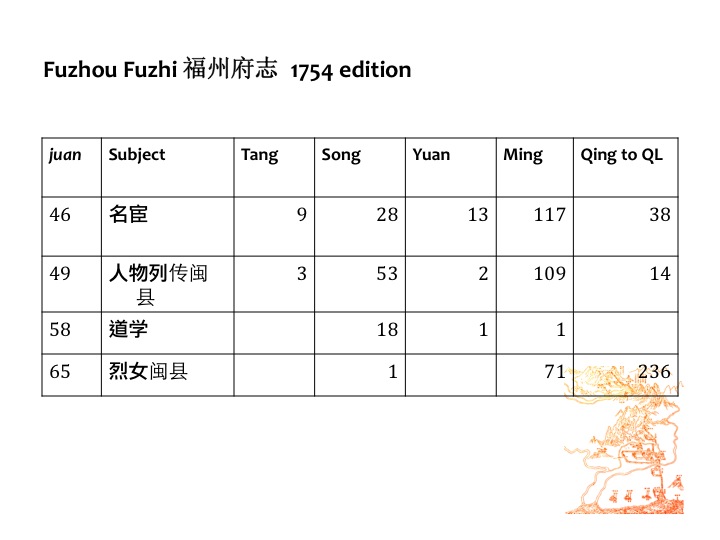
Table from the 1754 Fuzhou gazetteer: four juan by subject and dynasty - notable officials 9 Tang to 117 Ming, and 236 exemplary women in the Qing.
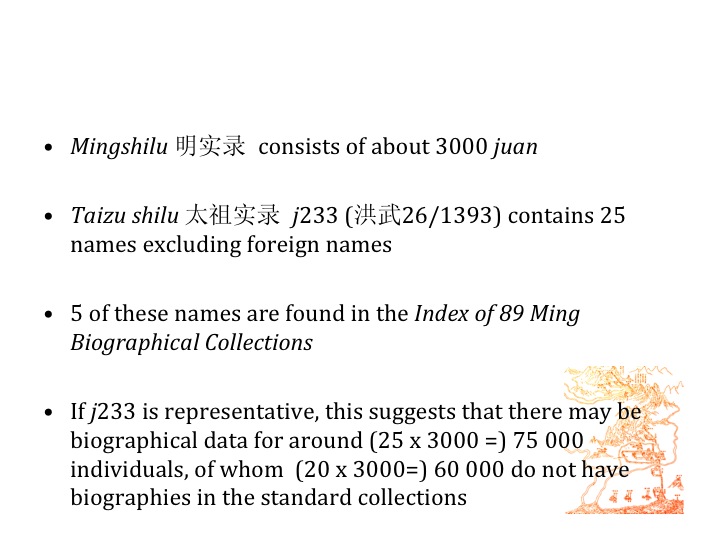
Slide on the Ming shilu: about 3,000 juan; one juan holds 25 names, of which 5 appear in an index of 89 Ming collections, implying some 75,000 people.
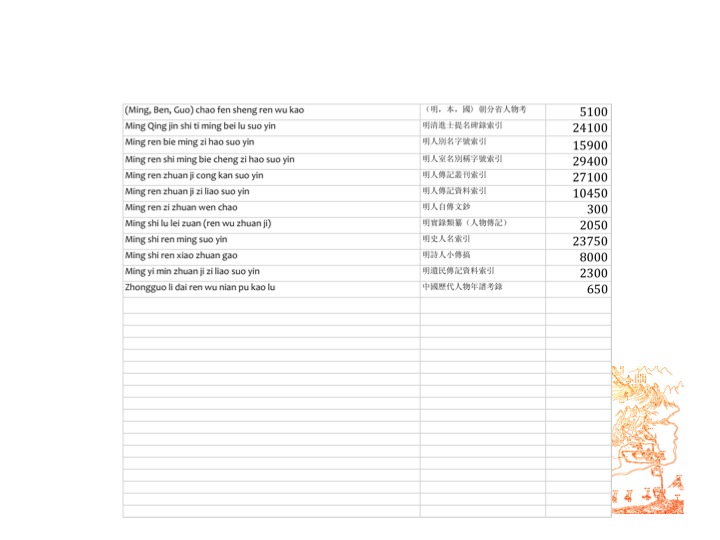
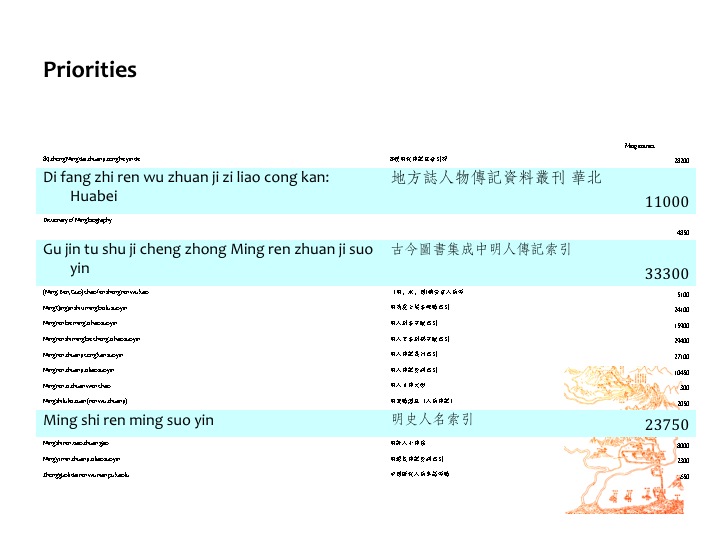
Table of Ming biographical indexes with entry counts: a name-and-style index 29,400, a jinshi stele index 24,100, a Ming shi name index 23,750, and nine more.
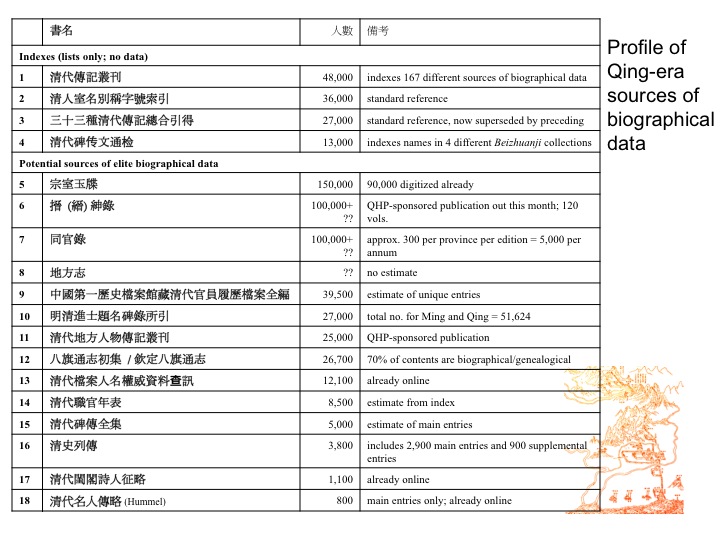
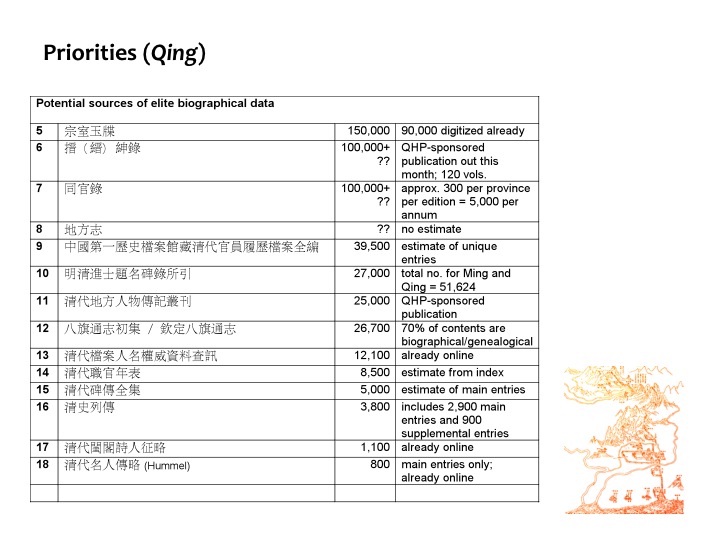
Slide 'Profile of Qing-era sources of biographical data': four index-only works, then eighteen potential sources with counts, from 150,000 down to 800.
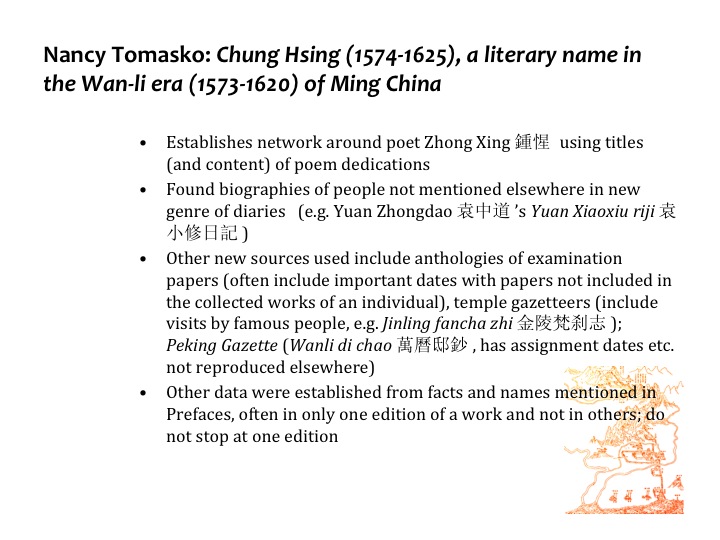
Slide on Nancy Tomasko's study of the poet Zhong Xing: networks built from poem dedications, plus lives found in diaries, anthologies and gazetteers.
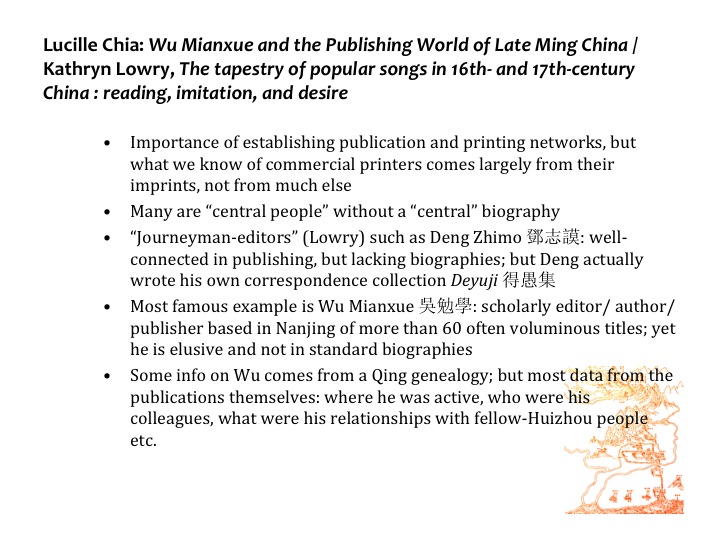
Slide on Lucille Chia and Kathryn Lowry: printers and journeyman-editors are central people without a central biography, known mainly from their own imprints.
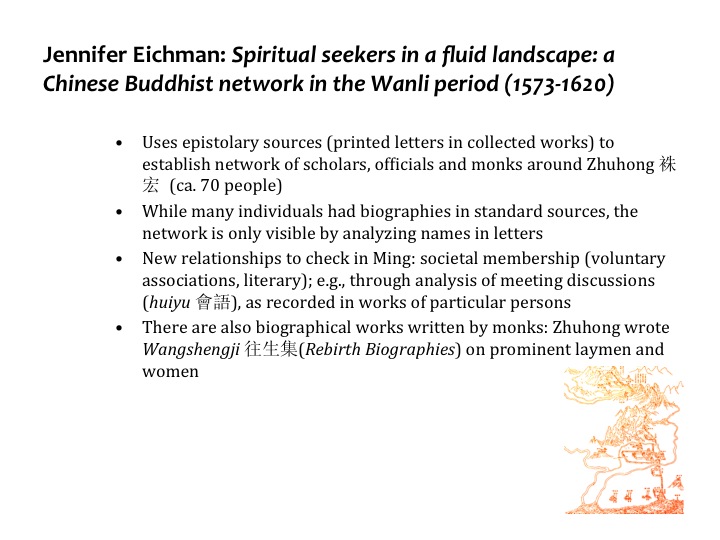
Slide on Jennifer Eichman: printed letters in collected works reveal a network of some 70 scholars, officials and monks around the monk Zhuhong.
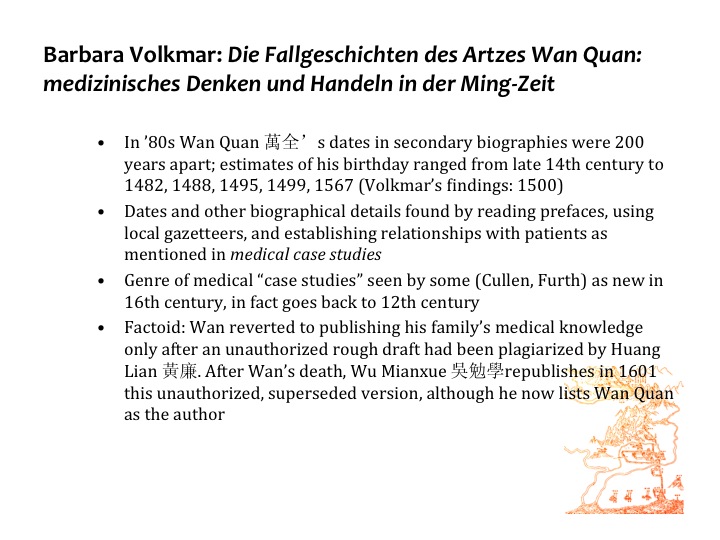
Slide on Barbara Volkmar's study of the physician Wan Quan: secondary biographies put his dates 200 years apart, resolved from prefaces and case studies.
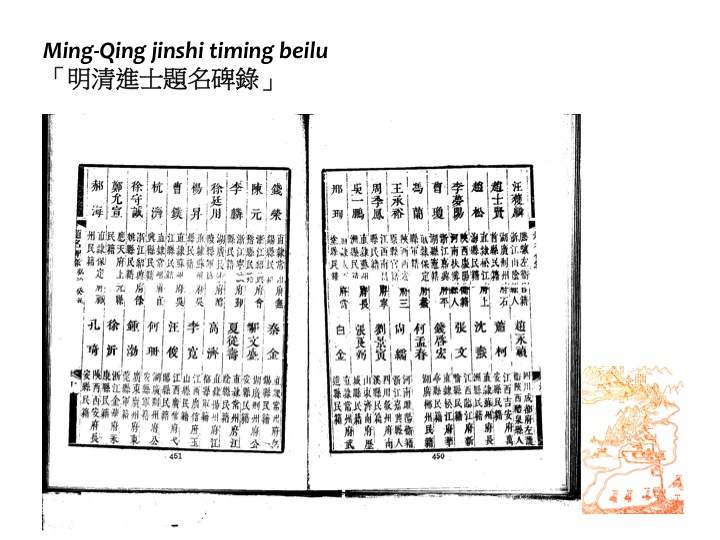
Two photographed pages of the Ming-Qing jinshi timing beilu, the stele record of examination graduates, in dense columns of names.
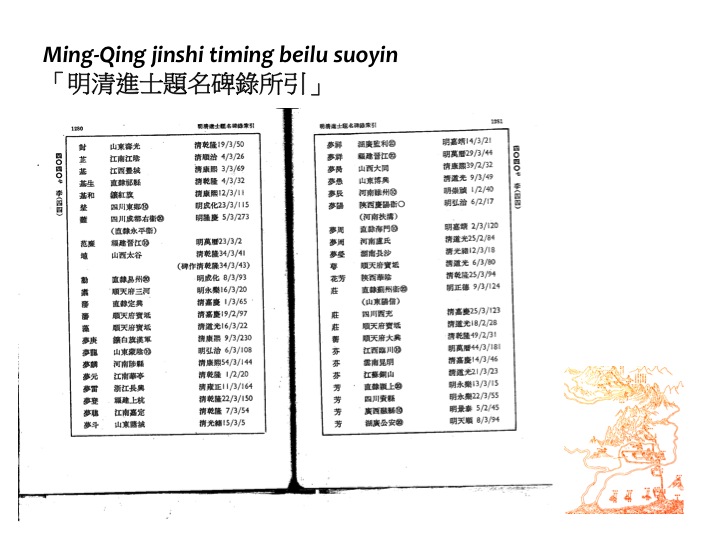
Two photographed pages of the index to the Ming-Qing jinshi stele record, listing given names with reign-era and volume references.
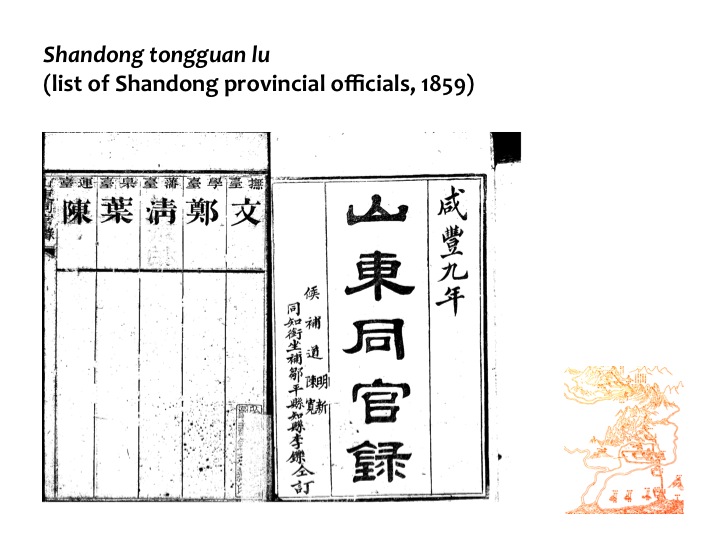
The cover and first page of the Shandong tongguan lu, a list of Shandong provincial officials of 1859.
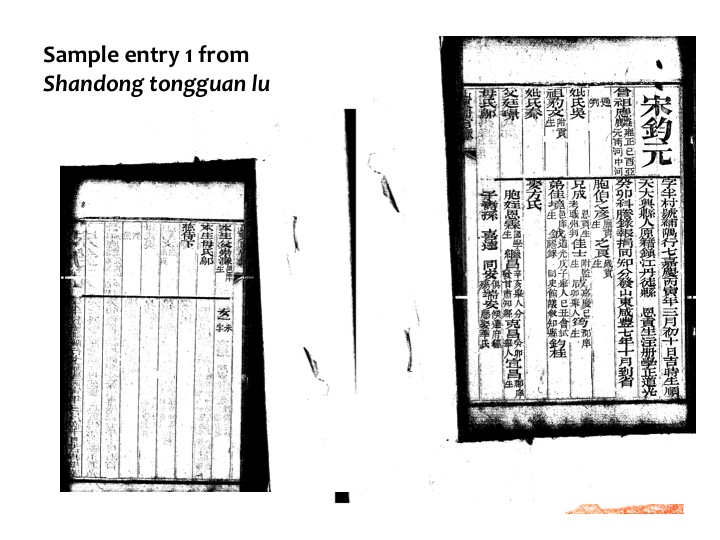
A sample entry from the Shandong tongguan lu: a printed record giving one official's native place, degree, kin and career in ruled columns.
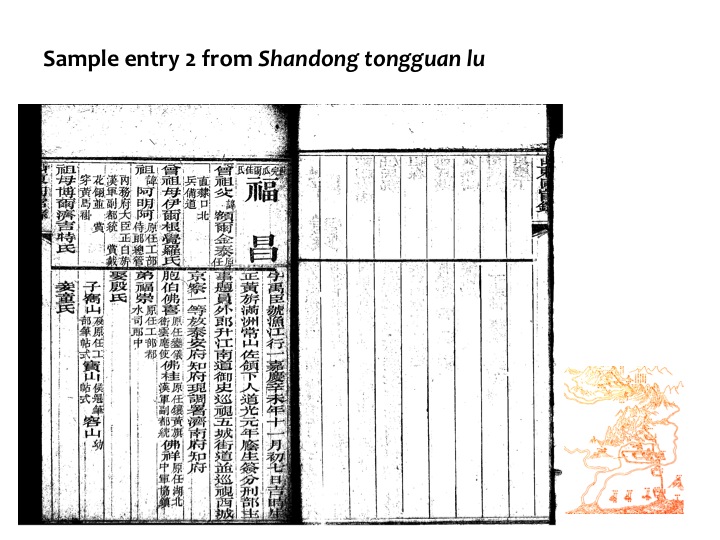
A second sample entry from the Shandong tongguan lu, its columns listing forebears, brothers, wives and offices.
Slide 'Priorities': Ming reference works by entry count, highlighting a gazetteer biographical series at 11,000 and two name indexes at 33,300 and 23,750.
Slide 'Priorities (Qing)': the same table of eighteen potential Qing sources with counts and notes on what is already digitized or online.
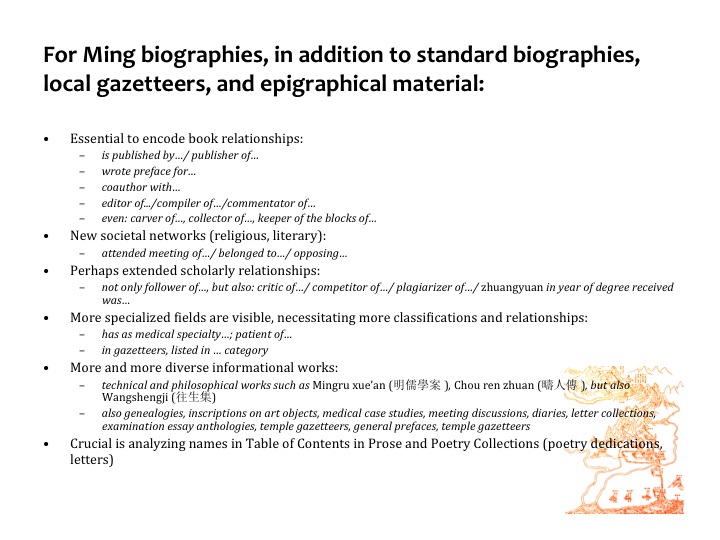
Slide on what Ming biographies need beyond standard sources: encoding book relationships, new societal networks, extended scholarly relations, new fields.
China Biographical Database Project (CBDB)

© China Biographical Database. Except where otherwise noted, content on this site is licensed under a Creative Commons Attribution-NonCommercial-ShareAlike 4.0 International license.

Admin login
Harvard University
Copyright © 2026 The President and Fellows of Harvard College
Accessibility Digital Accessibility Report Copyright Infringement Info Practices