Skip to main content arrow_circle_down
Harvard University
China Biographical Database Project (CBDB)
  • HOME
  • About Us
    • History of CBDB
    • Core Institutions and Editors
    • Funders
    • Collaborators
    • Working Groups for Historical Periods
    • Technical Development and Text Mining
    • Current Subprojects in Harvard
    • Past Subprojects in Harvard
    • Crowdsourcing Projects
    • Open Source Community(GitHub)
    • Exclusive Commercial License
    • Visiting CBDB Cambridge
  • Methodology
    • Prosopography
    • GIS: Mapping and Analyzing
    • Social Networks
  • Sources
    • How CBDB collects data and why you do not always find what you want
    • CBDB Sources
    • Coverage of CBDB
    • Structure of CBDB
  • Events
    • CBDB 20th Anniversary Symposium
    • Cyberinfrastructure Conference
    • International conference on the cyberinfrastructure for historical China studies
    • 2007 Prosopography of Middle Period China
    • 2008 First International Workshop on Biographical Databases for China's History
    • 2010 Computational Method & China's History
    • 2013 Tang Workshop
    • 2014 Training Workshops around the World
    • 2015 Training Workshops around the World
    • 2016 Training Workshops around the World
    • 2016 Keynote Talk on CBDB by Professor Ping-tzu Chu in Taiwan
    • Plan for a Conference on Cyberinfrastructure
  • Download Center
    • Download CBDB Standalone Database
    • Supporting Documents
    • Presentations and Papers
    • Download Supporting Software
    • CBDBRegexMachine
    • Data Sets
    • CBDB API
    • CBDB Linked Open Data
    • Report an Error
  • Blog
    • Newest blogs
    • Previous blogs
  • 中文

Breadcrumbs

  1. Home chevron_right
  2. Galleries chevron_right
  3. Creating Web Services and System Interoperability

Creating Web Services and System Interoperability

Created on : July 29, 2015

Speakers: Renée Sieber, Christopher Wellen, Lex Berman, Sophia Huang, Zhang Chuanron
Creating Web Services and System Interoperability - the case of Ming Qing Women's Writings, the China Biographical Database, and the China Historical Geographic Information System

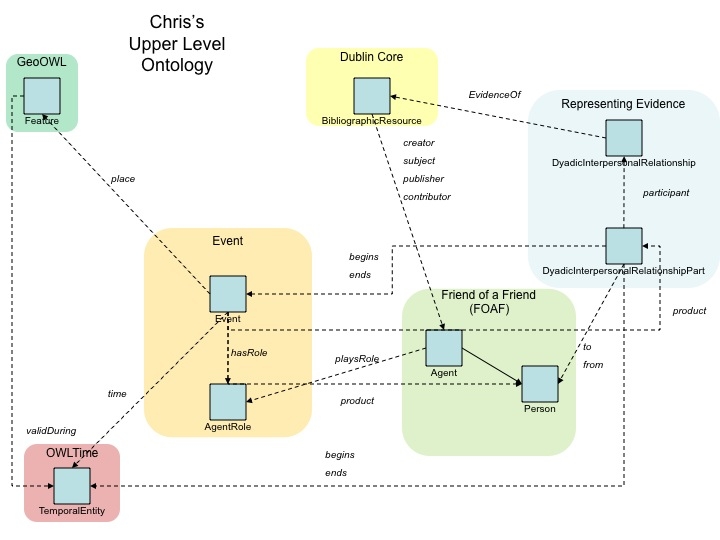
Title slide: Upper level ontology and architecture, Draft 1.
Diagram 'Chris's Upper Level Ontology': coloured groups for GeoOWL, Dublin Core, Representing Evidence, Event, FOAF and OWLTime, linked by place and hasRole.
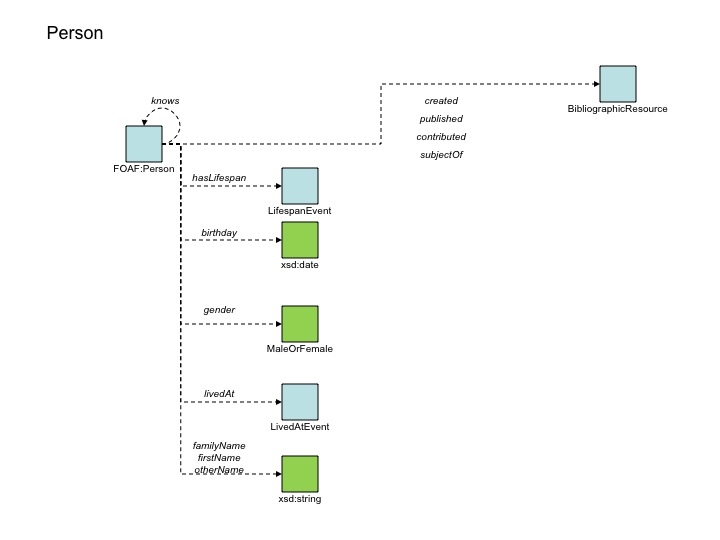
Diagram 'Person': FOAF:Person linked by knows to itself and by hasLifespan, birthday, gender, livedAt and name properties to event and literal types.
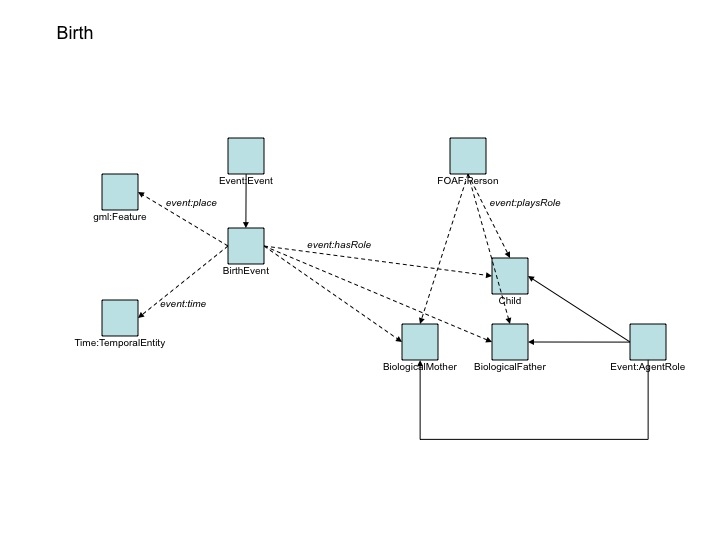
Diagram 'Birth': a BirthEvent with place, time and hasRole, whose roles Child, BiologicalMother and BiologicalFather are played by FOAF:Person.
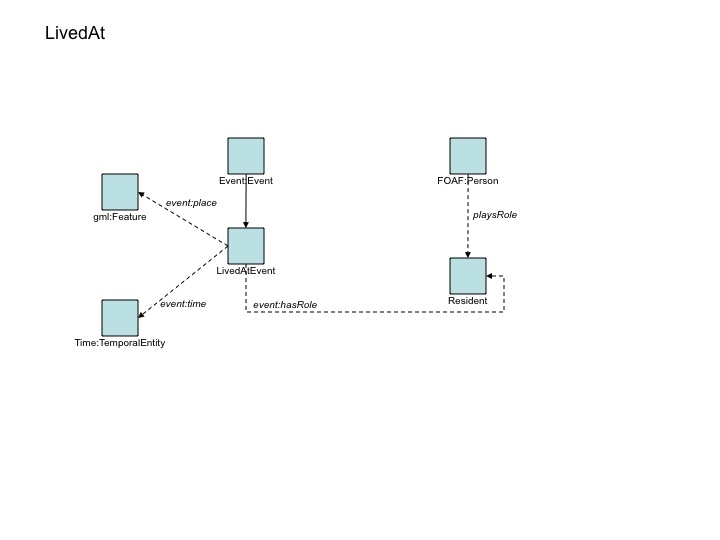
Diagram 'LivedAt': a LivedAtEvent with place and time, whose single role Resident is played by a FOAF:Person.
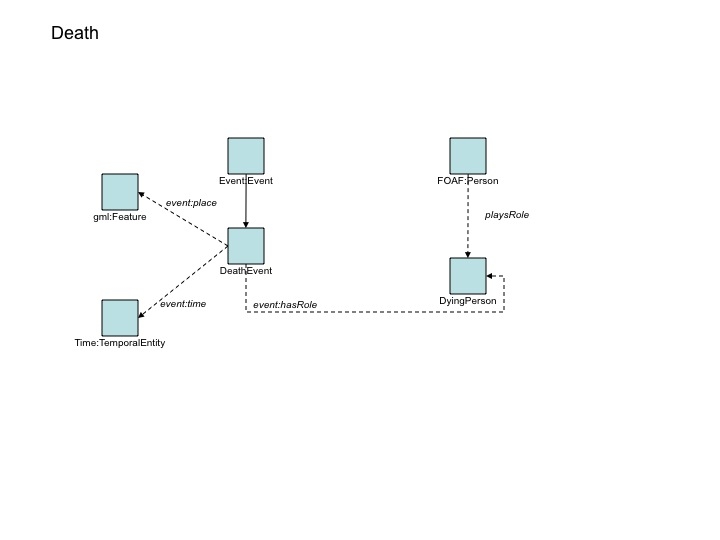
Diagram 'Death': a DeathEvent with place and time, whose role DyingPerson is played by a FOAF:Person.
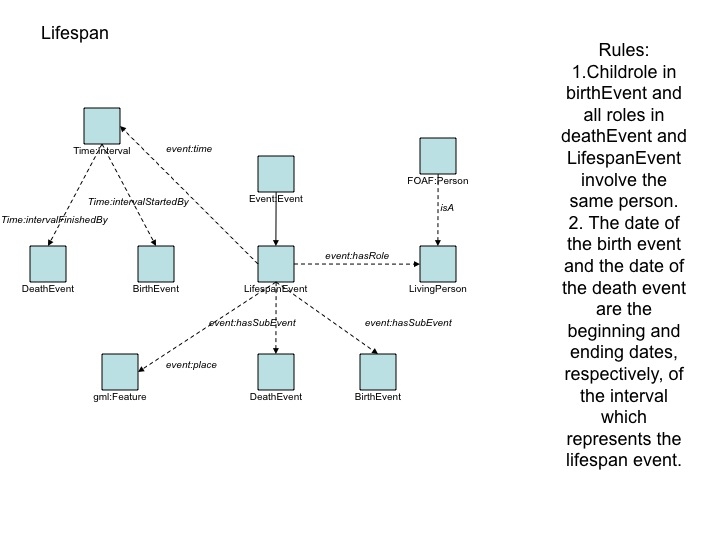
Diagram 'Lifespan': a LifespanEvent bounded by birth and death sub-events, with rules that all roles are one person and the interval runs birth to death.
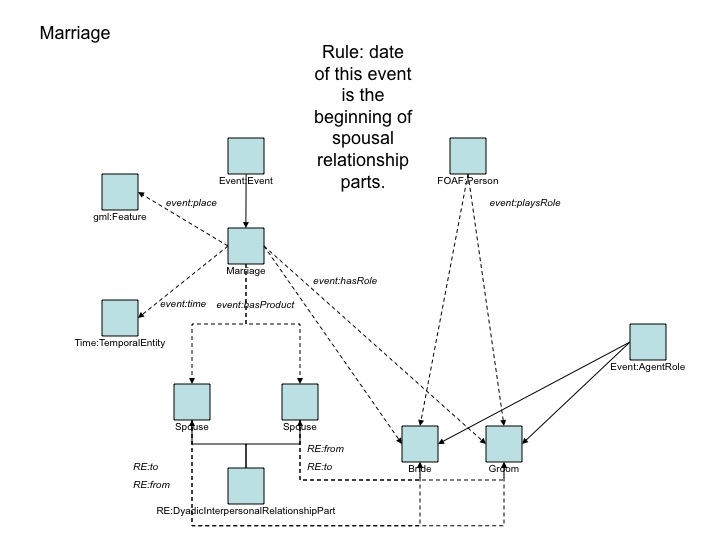
Diagram 'Marriage': a Marriage event with place, time, the roles Bride and Groom and two Spouse products, noting the event date begins the spousal relationship.
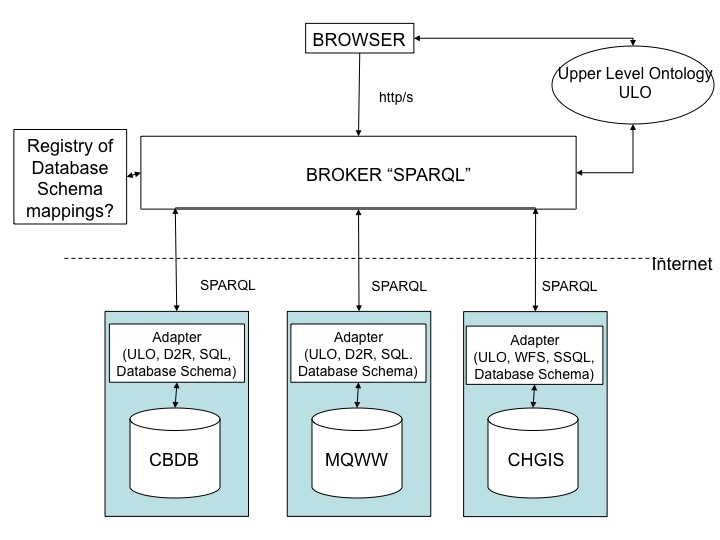
Architecture diagram: a browser talks over http to a SPARQL broker, which consults the upper ontology and queries adapters in front of CBDB, MQWW and CHGIS.
China Biographical Database Project (CBDB)

© China Biographical Database. Except where otherwise noted, content on this site is licensed under a Creative Commons Attribution-NonCommercial-ShareAlike 4.0 International license.

Admin login
Harvard University
Copyright © 2026 The President and Fellows of Harvard College
Accessibility Digital Accessibility Report Copyright Infringement Info Practices