Skip to main content arrow_circle_down
Harvard University
China Biographical Database Project (CBDB)
  • HOME
  • About Us
    • History of CBDB
    • Core Institutions and Editors
    • Funders
    • Collaborators
    • Working Groups for Historical Periods
    • Technical Development and Text Mining
    • Current Subprojects in Harvard
    • Past Subprojects in Harvard
    • Crowdsourcing Projects
    • Open Source Community(GitHub)
    • Exclusive Commercial License
    • Visiting CBDB Cambridge
  • Methodology
    • Prosopography
    • GIS: Mapping and Analyzing
    • Social Networks
  • Sources
    • How CBDB collects data and why you do not always find what you want
    • CBDB Sources
    • Coverage of CBDB
    • Structure of CBDB
  • Events
    • CBDB 20th Anniversary Symposium
    • Cyberinfrastructure Conference
    • International conference on the cyberinfrastructure for historical China studies
    • 2007 Prosopography of Middle Period China
    • 2008 First International Workshop on Biographical Databases for China's History
    • 2010 Computational Method & China's History
    • 2013 Tang Workshop
    • 2014 Training Workshops around the World
    • 2015 Training Workshops around the World
    • 2016 Training Workshops around the World
    • 2016 Keynote Talk on CBDB by Professor Ping-tzu Chu in Taiwan
    • Plan for a Conference on Cyberinfrastructure
  • Download Center
    • Download CBDB Standalone Database
    • Supporting Documents
    • Presentations and Papers
    • Download Supporting Software
    • CBDBRegexMachine
    • Data Sets
    • CBDB API
    • CBDB Linked Open Data
    • Report an Error
  • Blog
    • Newest blogs
    • Previous blogs
  • 中文

Breadcrumbs

  1. Home chevron_right
  2. Galleries chevron_right
  3. >>> Identifying Relationships in Unstructured Texts (Rani Nelken, Elif Yamangil, Wang Xiaoxuan)

>>> Identifying Relationships in Unstructured Texts (Rani Nelken, Elif Yamangil, Wang Xiaoxuan)

Created on : July 29, 2015

From Named Entity Recognition to Identifying Relationships in Unstructured Texts
Title slide: Identifying Relationships in Unstructured Texts, by Elif Yamangil and Rani Nelken, Harvard School of Engineering and Applied Sciences.
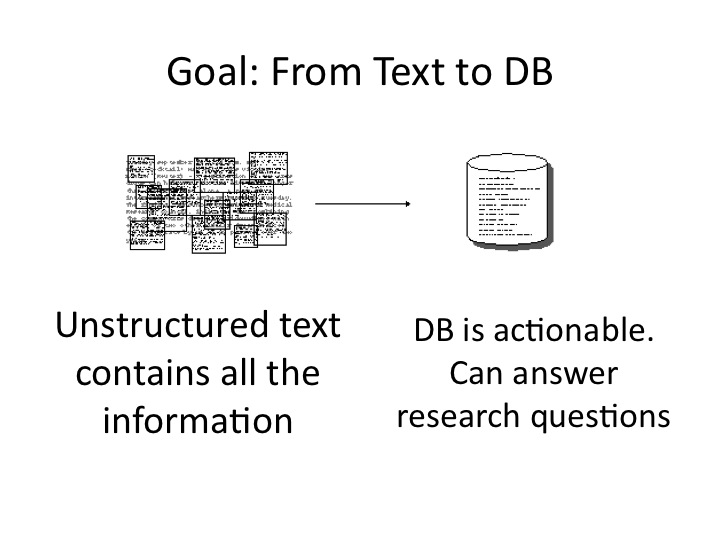
Slide 'Goal: From Text to DB': an arrow from a pile of text fragments to a database cylinder; the text holds the information, the database can answer questions.
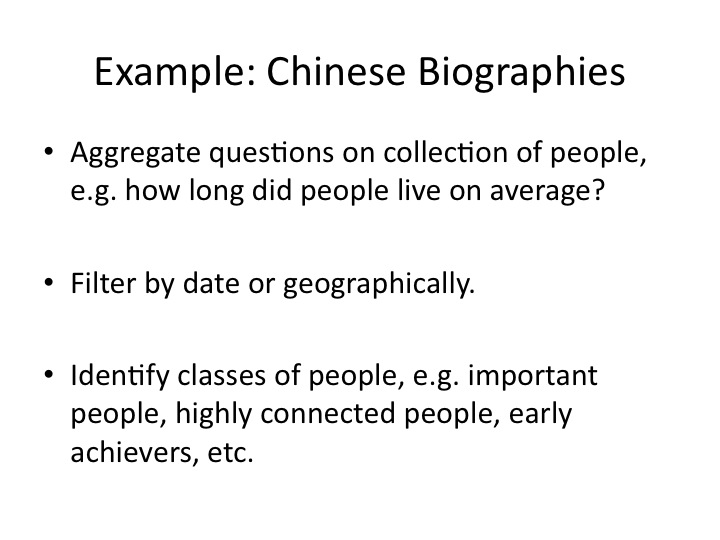
Slide 'Example: Chinese Biographies': aggregate questions such as average lifespan, filtering by date or geography, and identifying classes of people.
Slide with the single statement: the current manual approach equals a bottleneck.
Slide 'Solution: Automatic Text Understanding', answered by the HAL 9000 line, I'm sorry Dave, I'm afraid I can't do that.
Slide with the single statement: language is ambiguous.
Slide 'What's practical?', answered with two words: Information Extraction.
Slide 'Information Extraction': extract the pieces salient to the user's needs - who did what to whom - and link back to the original text for reference.
Slide 'Applications: Business', with the single example mergers and acquisitions.
Slide 'Applications: Biomedical', with the single example mining the bibliome.
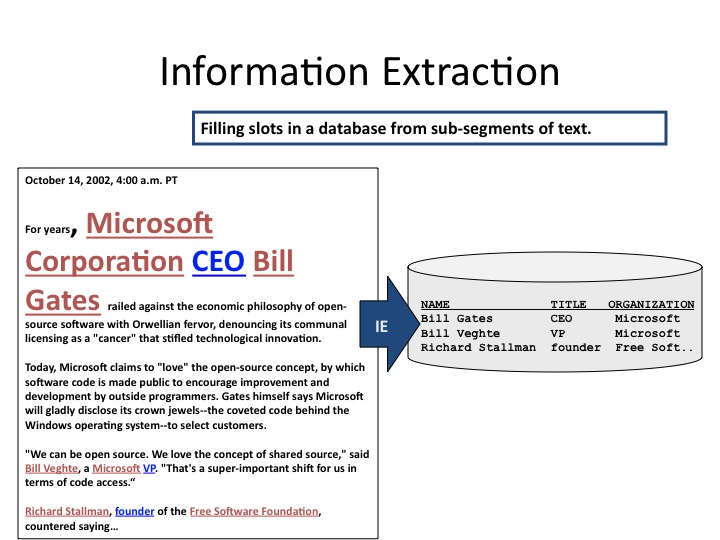
Slide on filling database slots from sub-segments of text: a 2002 news story about Microsoft becomes a table of name, title and organization.
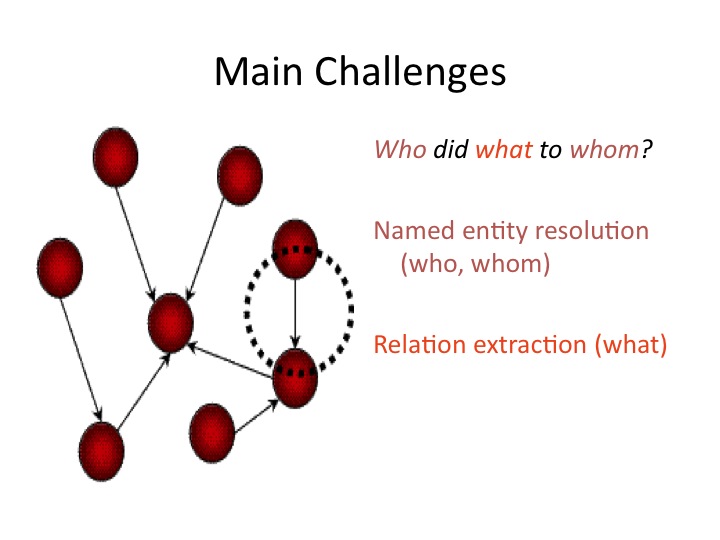
Slide 'Main Challenges' beside a graph of red nodes and arrows: who did what to whom, named entity resolution for who and whom, relation extraction for what.
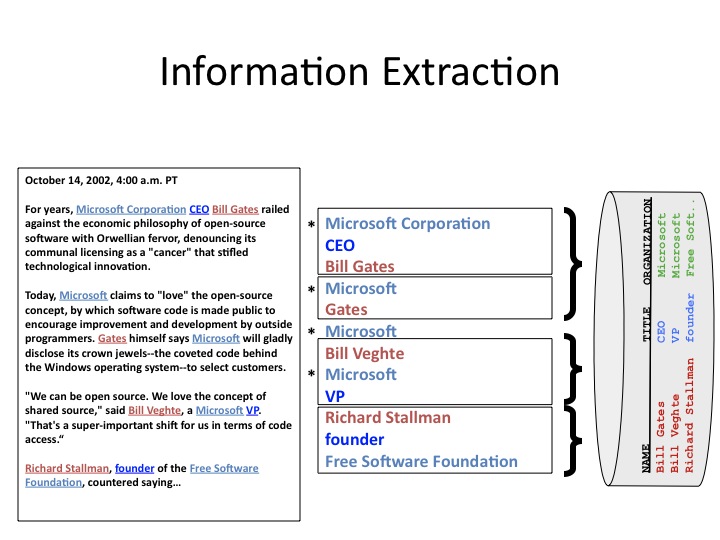
Slide showing the same Microsoft news story with three extracted triples - Microsoft, CEO, Bill Gates and so on - grouped by braces into a database cylinder.
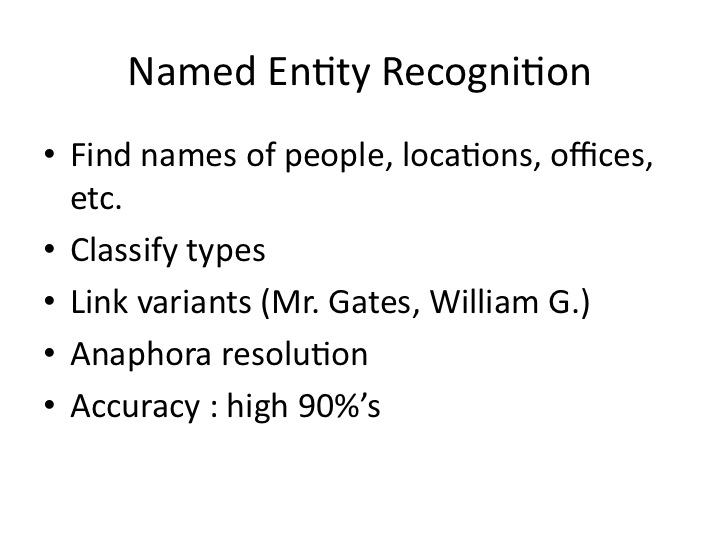
Slide 'Named Entity Recognition': find names of people, locations and offices, classify types, link variants such as Mr. Gates and William G., resolve anaphora.
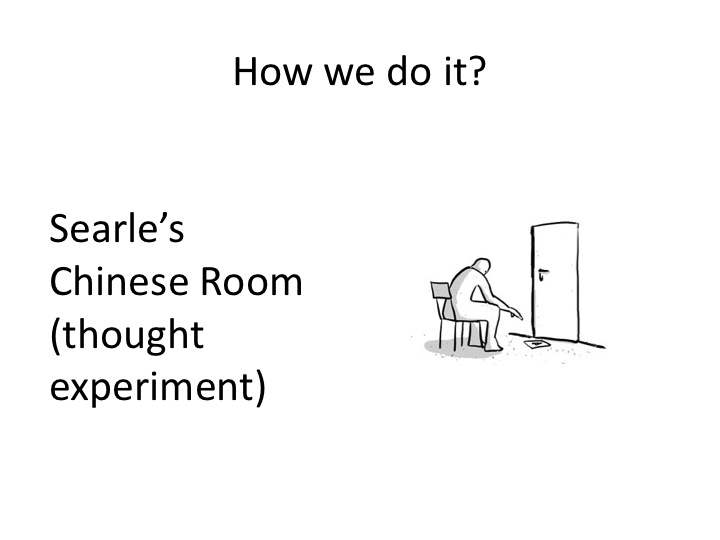
Slide 'How we do it?': Searle's Chinese Room thought experiment, with a cartoon of a person on a chair passing a note under a closed door.
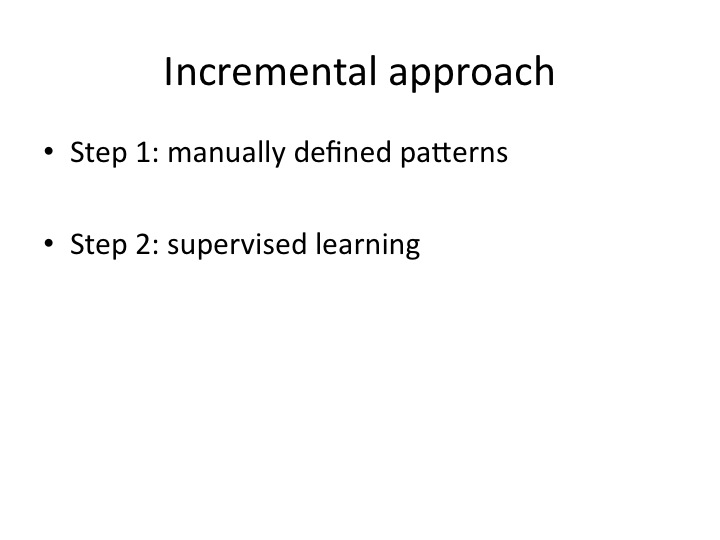
Slide 'Incremental approach': step 1, manually defined patterns; step 2, supervised learning.
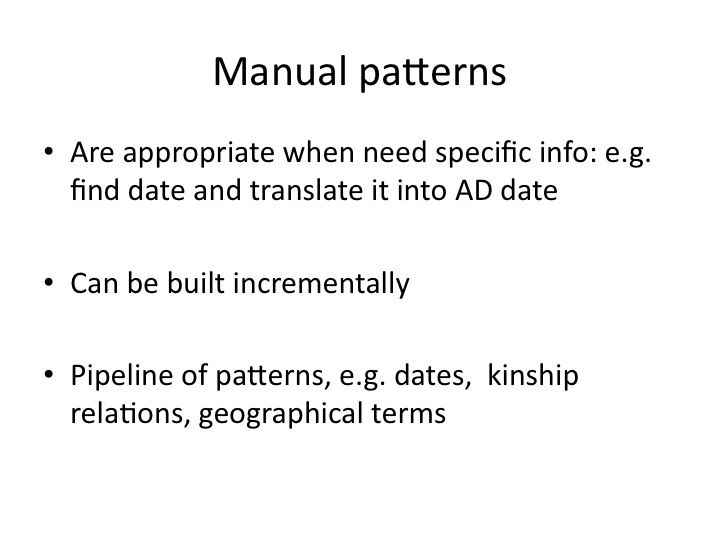
Slide 'Manual patterns': appropriate when specific information is needed, such as converting a date to AD; built incrementally as a pipeline of patterns.
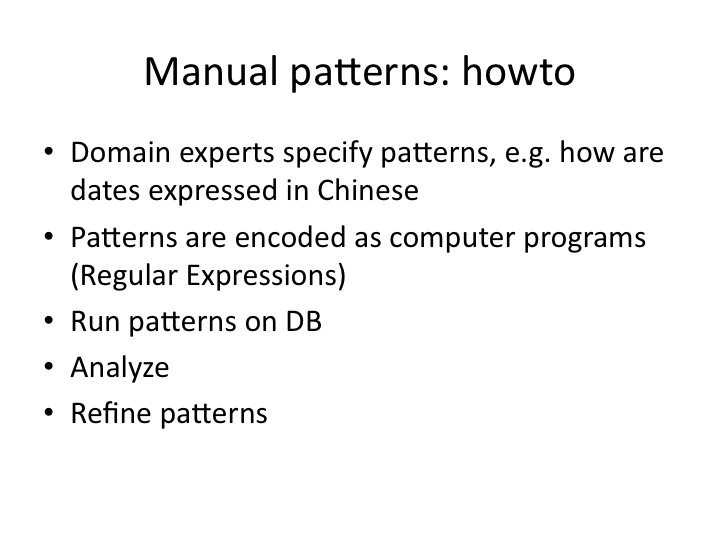
Slide 'Manual patterns: howto': domain experts specify the patterns, they are encoded as regular expressions, run on the database, analysed, then refined.
China Biographical Database Project (CBDB)

© China Biographical Database. Except where otherwise noted, content on this site is licensed under a Creative Commons Attribution-NonCommercial-ShareAlike 4.0 International license.

Admin login
Harvard University
Copyright © 2026 The President and Fellows of Harvard College
Accessibility Digital Accessibility Report Copyright Infringement Info Practices