Skip to main content arrow_circle_down
Harvard University
China Biographical Database Project (CBDB)
  • HOME
  • About Us
    • History of CBDB
    • Core Institutions and Editors
    • Funders
    • Collaborators
    • Working Groups for Historical Periods
    • Technical Development and Text Mining
    • Current Subprojects in Harvard
    • Past Subprojects in Harvard
    • Crowdsourcing Projects
    • Open Source Community(GitHub)
    • Exclusive Commercial License
    • Visiting CBDB Cambridge
  • Methodology
    • Prosopography
    • GIS: Mapping and Analyzing
    • Social Networks
  • Sources
    • How CBDB collects data and why you do not always find what you want
    • CBDB Sources
    • Coverage of CBDB
    • Structure of CBDB
  • Events
    • CBDB 20th Anniversary Symposium
    • Cyberinfrastructure Conference
    • International conference on the cyberinfrastructure for historical China studies
    • 2007 Prosopography of Middle Period China
    • 2008 First International Workshop on Biographical Databases for China's History
    • 2010 Computational Method & China's History
    • 2013 Tang Workshop
    • 2014 Training Workshops around the World
    • 2015 Training Workshops around the World
    • 2016 Training Workshops around the World
    • 2016 Keynote Talk on CBDB by Professor Ping-tzu Chu in Taiwan
    • Plan for a Conference on Cyberinfrastructure
  • Download Center
    • Download CBDB Standalone Database
    • Supporting Documents
    • Presentations and Papers
    • Download Supporting Software
    • CBDBRegexMachine
    • Data Sets
    • CBDB API
    • CBDB Linked Open Data
    • Report an Error
  • Blog
    • Newest blogs
    • Previous blogs
  • 中文

Breadcrumbs

  1. Home chevron_right
  2. Galleries chevron_right
  3. >>> Modeling Life Histories of the Han and the Medieval Dynasties (Xiaofei Tian)

>>> Modeling Life Histories of the Han and the Medieval Dynasties (Xiaofei Tian)

Created on : July 29, 2015

Modeling life histories of the Han and the medieval dynasties

Title slide: Characteristics of Wei-Jin-Nanbeichao biographies and the design of CBDB, by Luo Xin, Center for Ancient Chinese History, Peking University.
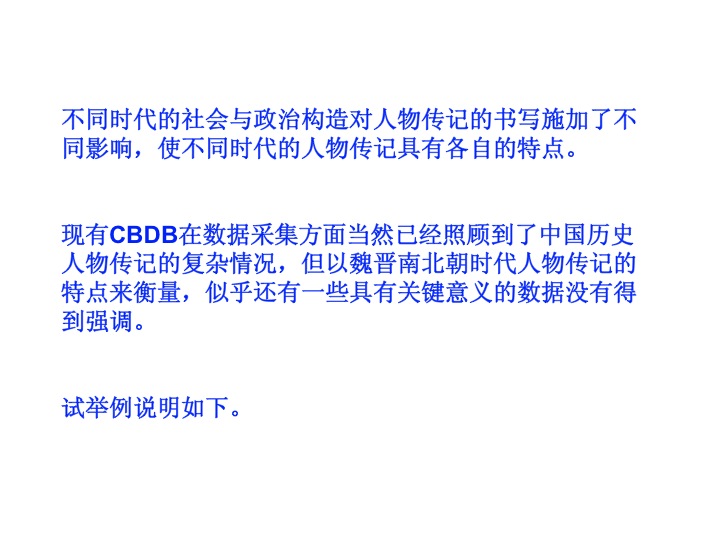
Slide: each era's social and political structure shaped how biographies were written; CBDB's model still leaves key features of medieval biography unstressed.
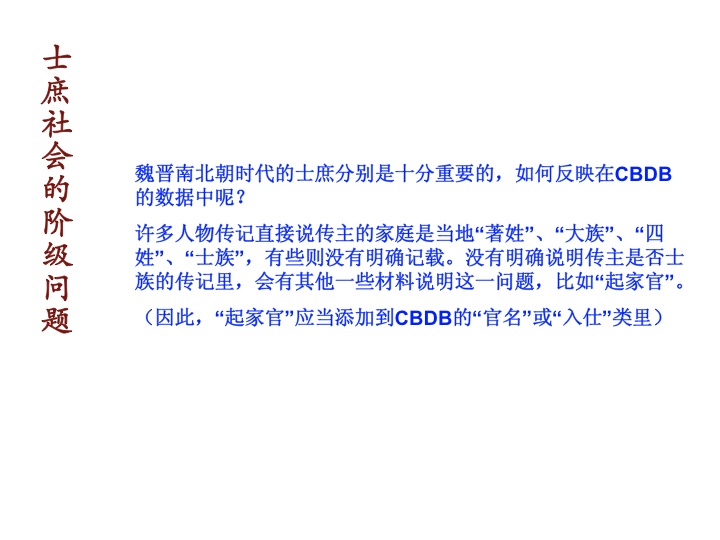
Slide 'Class in shi-shu society': how should shi/shu status enter CBDB? Where unstated, the first office (qijia guan) reveals it, so that field should be added.
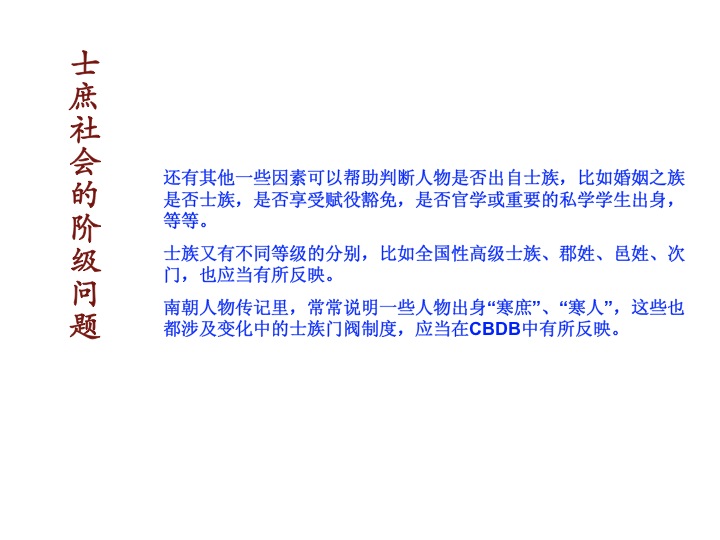
Slide, continued: shi status also shows in marriage, tax exemption and schooling; the grades of shi lineages and the Southern 'hanshu' class should be recorded.
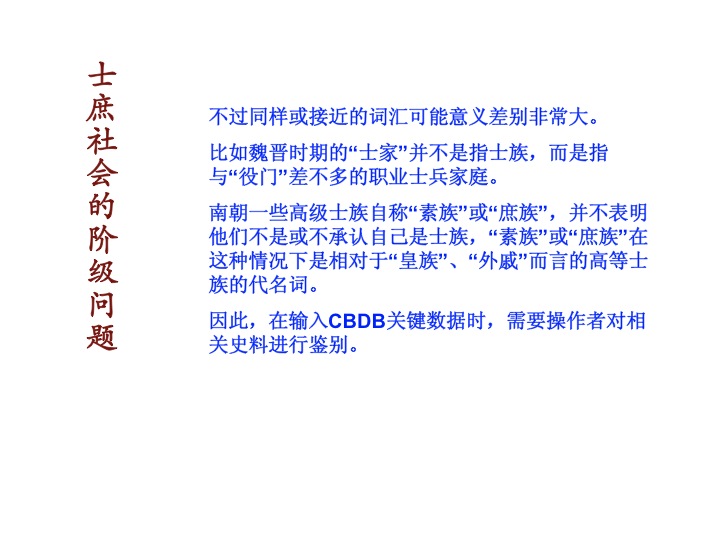
Slide, continued: similar terms differ sharply - Wei-Jin 'shijia' meant soldier families, not shi lineages, so editors must judge sources before entering data.
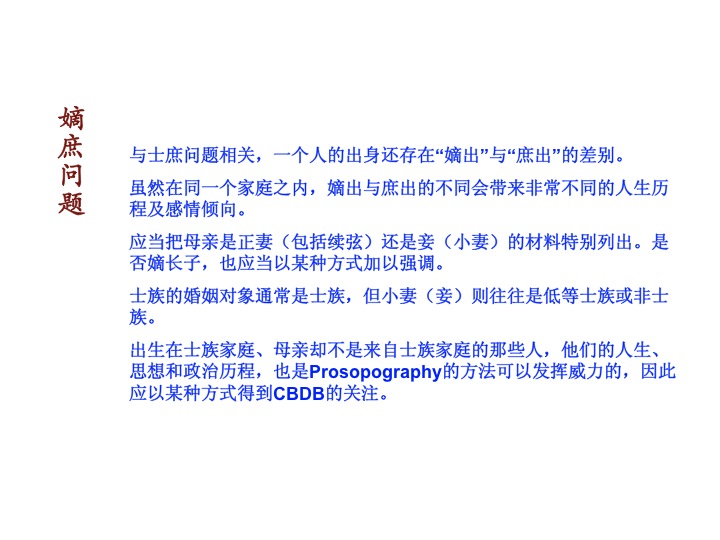
Slide on principal versus concubine birth: whether the mother was a principal wife and whether a son was the main heir shaped lives and should be recorded.
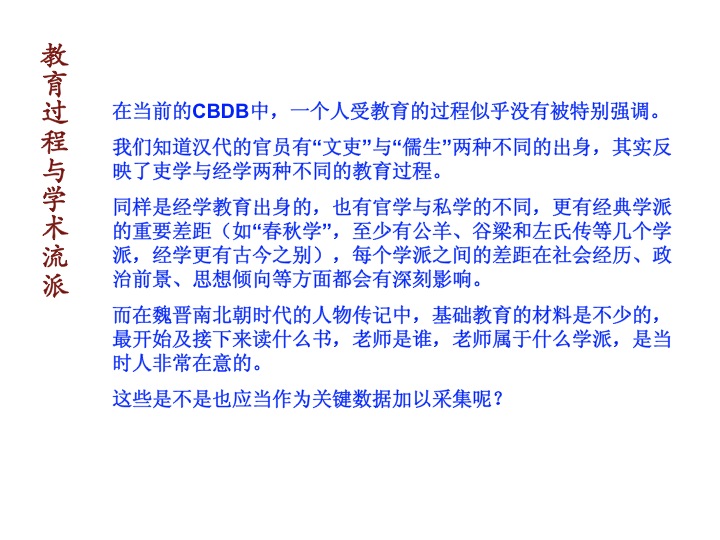
Slide on education: Han officials came as clerks or classicists, and classical learning split into official, private and separate school traditions.
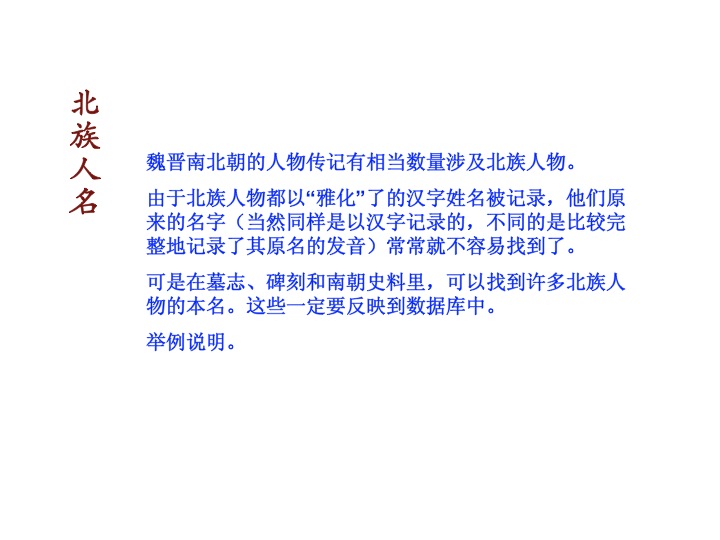
Slide on northern names: many subjects were of northern origin, their sinicised names hiding the original, recoverable from epitaphs and Southern histories.
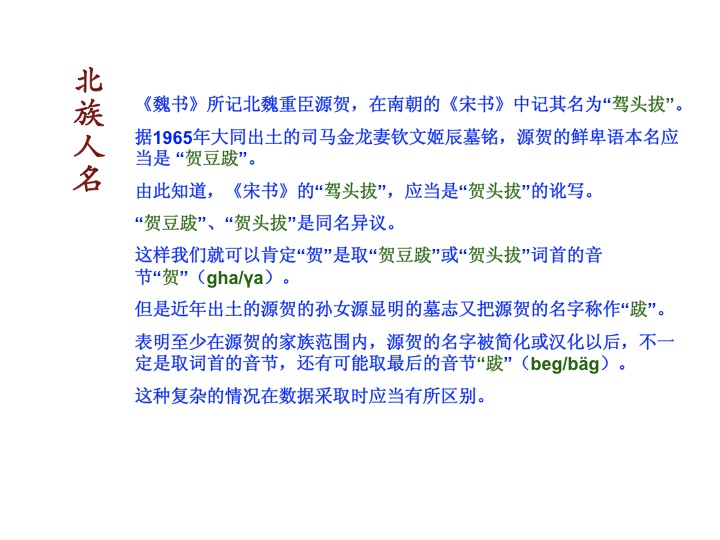
Slide: Yuan He of the Wei shu appears as Jiatouba in the Song shu; a 1965 epitaph from Datong shows Hedouba, while a granddaughter's epitaph gives beg/bag.
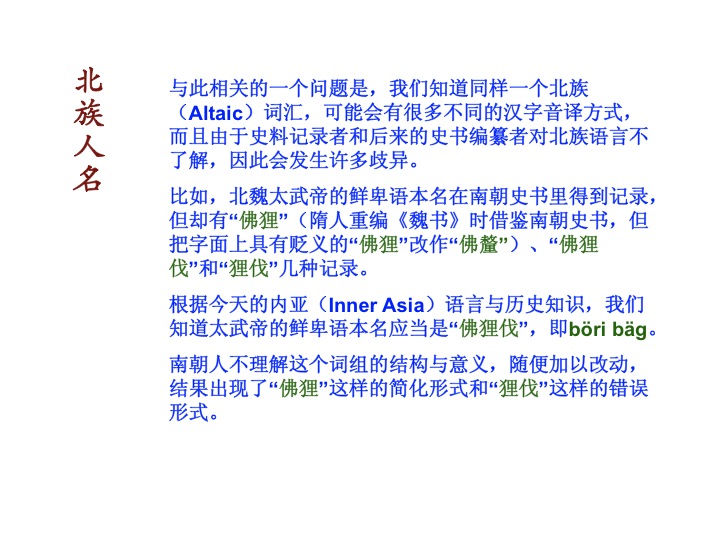
Slide: one Altaic word yielded many Chinese transcriptions - Emperor Taiwu's Xianbei name appears in four variant forms, reconstructed as bori bag.
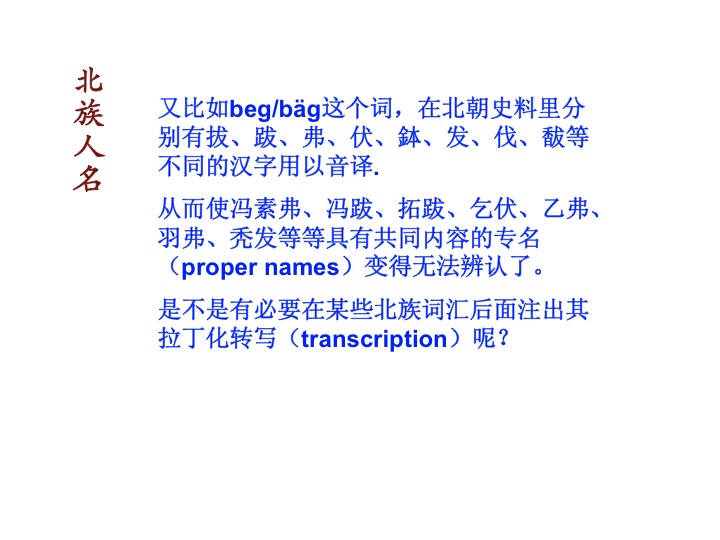
Slide: beg/bag was transcribed with at least eight characters, making names such as Feng Sufu, Feng Ba, Tuoba and Yifu unrecognisable; add romanisation?
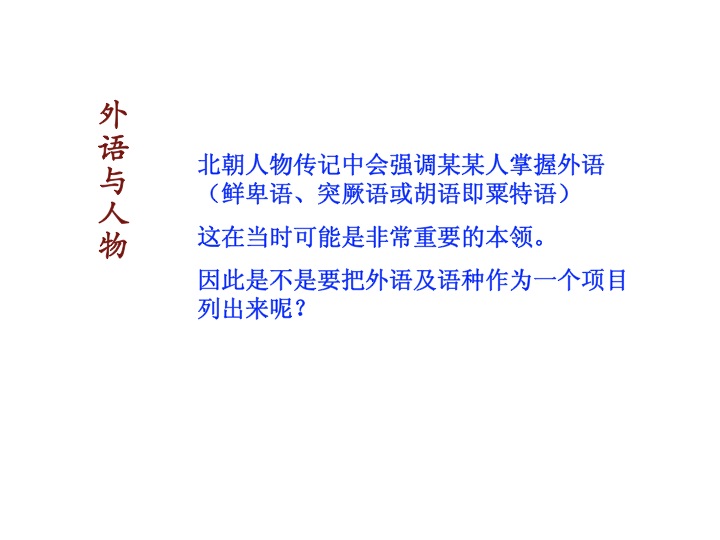
Slide 'Foreign languages': Northern biographies stress command of Xianbei, Turkic or Sogdian, a valued skill; should language ability be a field of its own?
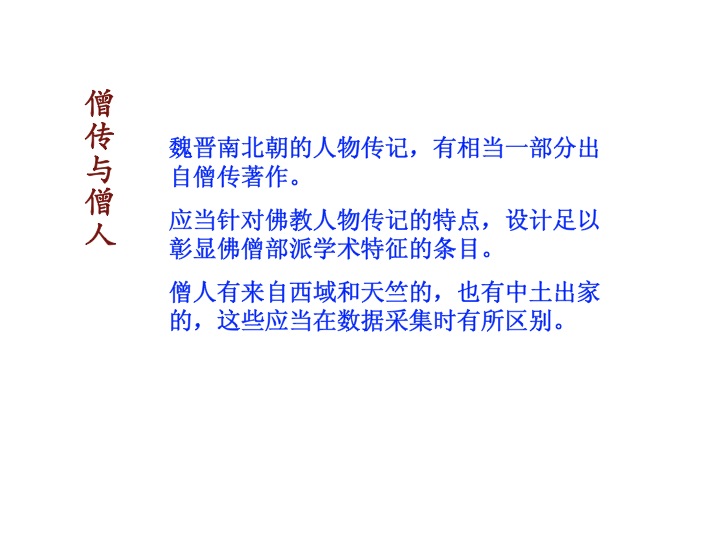
Slide on monk biographies: many come from monk collections, so fields should capture sectarian learning and foreign versus native ordination.
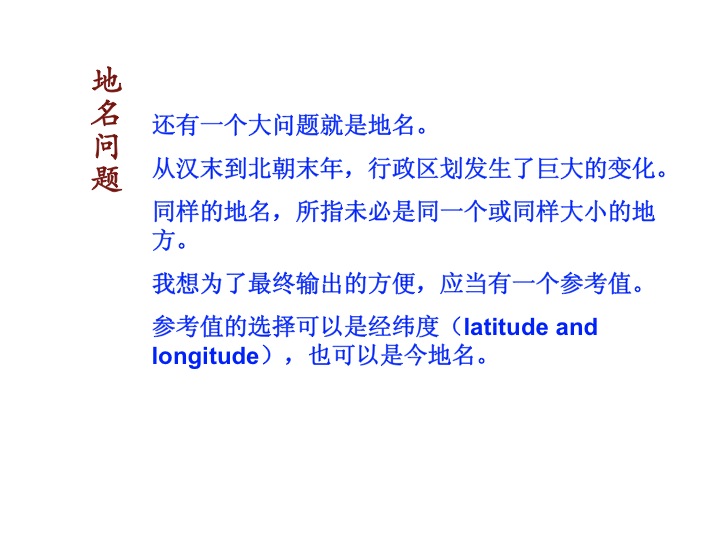
Slide on place names: administrative geography changed enormously, so one name need not mean one place; a reference value or modern name is needed.
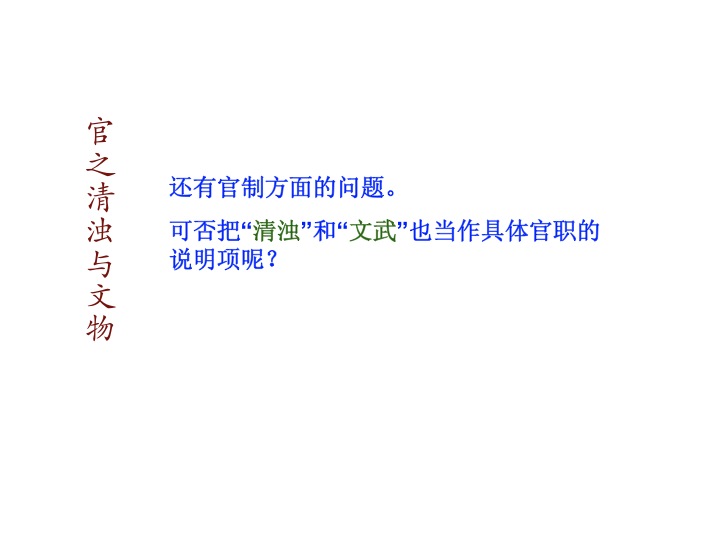
Slide on office rank: could the 'pure versus impure' distinction and the civil/military split also be recorded as attributes of a specific office?
Closing slide: the single Chinese word for thank you, in green.
China Biographical Database Project (CBDB)

© China Biographical Database. Except where otherwise noted, content on this site is licensed under a Creative Commons Attribution-NonCommercial-ShareAlike 4.0 International license.

Admin login
Harvard University
Copyright © 2026 The President and Fellows of Harvard College
Accessibility Digital Accessibility Report Copyright Infringement Info Practices